
- 18 min read
- Flagship project
- Legal intelligence platform
- Built end to end
An AI legal intelligence platform built for how UK law firms actually work
Jurion reads every matter, deadline, document and message across a firm, then surfaces the missed revenue, the risks and the next best actions. Each role gets a workspace tuned to their job, all inside the compliance boundaries the SRA expects.
- Client
- Jurion AI Ltd
- Sector
- Legal technology
- Our role
- End-to-end product and engineering
- Regulatory posture
- Built for SRA, GDPR and AML
Jurion is the most ambitious project we've taken on. It's an enterprise AI platform built specifically for UK law firms, not repackaged from a US product with the labels swapped over.
We led it from first principles. Strategy, research, information architecture, brand, frontend engineering, the AI layer and the role-based permissions model. The workspace we shipped behaves like a senior colleague. It reads the matter, notices what's been missed, drafts a narrative that would pass an audit, and hands the partner a single page they can actually use on Monday morning. Clients finally get somewhere sensible to log in.
What we shipped
- Matter intelligence that reads every file on a case
- Time recovery worth ten to twenty percent of billable hours
- One-page briefings partners can hand round on Monday
- A client portal for messaging, documents and invoices
- Five role workspaces, from managing partner to client
- An audit trail built for SRA, GDPR and AML scrutiny
The shape of the engagement, at a glance
Legal technology
Enterprise software for UK law firms.
Enterprise AI platform
Multi-tenant, role-aware, built for a regulated sector.
- Product strategy
- Research and UX
- Brand and interface design
- Full-stack engineering
- AI layer
Growing and established firms
Managing partners, solicitors, paralegals, assistants and their clients.
- Legal intelligence
- Matter management
- Time recovery
- Client experience
- Everyday automation
Built for SRA, GDPR and AML
Data residency, audit trails and permission scoping designed in from day one.
Most legal software tells you what already happened. We wanted one that tells firms what to do next.
A UK law firm generates more data than most mid-sized enterprises. Every email, deadline, document and time entry across every matter, quietly accumulating in the background. Yet estimates put lost billable hours somewhere between ten and twenty percent, and compliance risk sits unwatched because no partner has the diary space to keep an eye on it.
The practice management systems firms already own solve a fraction of the problem. They store information without ever interpreting it. They report on activity without suggesting the next move. And they treat compliance like a filing cabinet, not something that could warn you about a matter drifting off course.
Jurion was designed to close that gap. It reads what the firm produces and surfaces the actions, risks and revenue that would otherwise slip past.
The comparison in one table
Traditional software
- Stores information
- Tracks tasks
- Records time
- Reports on the week just gone
- Shows the same view to everyone
- Waits to be asked
Jurion
- Spots the risks
- Suggests the next action
- Recovers the time already worked
- Writes partner-ready briefings
- Adapts to each role
- Prompts you before you have to ask
A well-run law firm shouldn't need three consultants and a data warehouse to see what's about to go wrong on Monday morning.
Three questions we designed against
What's the single most valuable thing this user could do right now?
Every screen surfaces one next action, ranked against matter urgency, deadlines and the revenue at stake.
What is the firm losing while nobody is looking?
Unbilled work, missing narratives, matters drifting into amber, compliance quietly slipping. Each one is quantified, visible and something you can act on.
How much of this can we automate without breaching regulation?
Every AI output is auditable, scoped to the reader's permissions and grounded in the firm's own data. No black boxes, and nothing leaves the tenant.
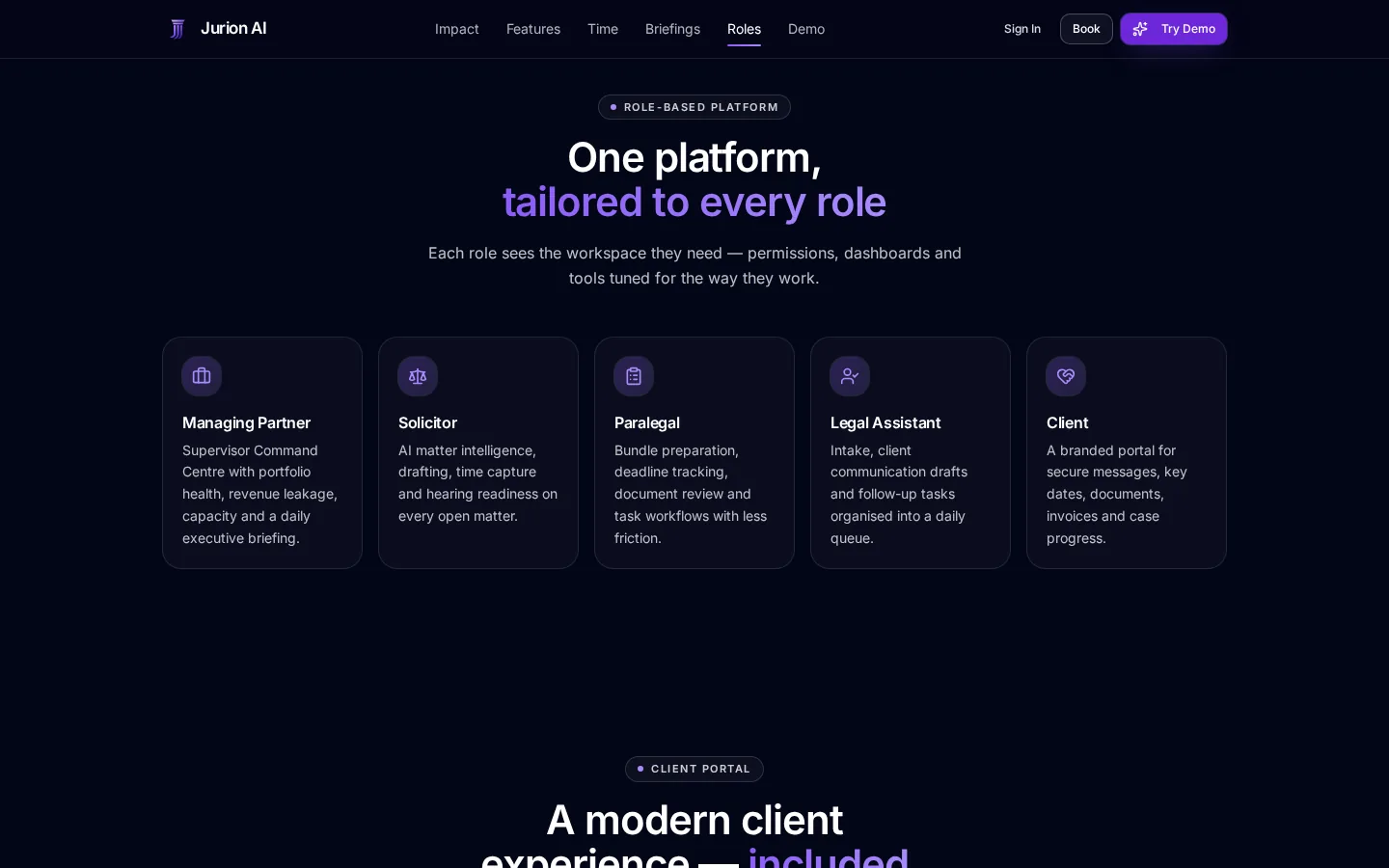
One product, five very different users
We sat down with managing partners, solicitors, paralegals, legal assistants and clients at mid-sized UK firms. What surprised us was how little their day-to-day work overlaps. Less than a fifth of it, in most cases.
A managing partner wants portfolio-level risk and revenue health at a glance, with the caveats already applied. A paralegal wants a deadline-driven queue that never quietly loses a matter. A client just wants to know where their case is, what they've paid, and when they'll next hear from someone.
A single dashboard would have failed all of them. We built five role workspaces instead. Each has its own metrics, defaults and permissions, but they all draw on the same underlying data model.
An AI colleague that understands legal work
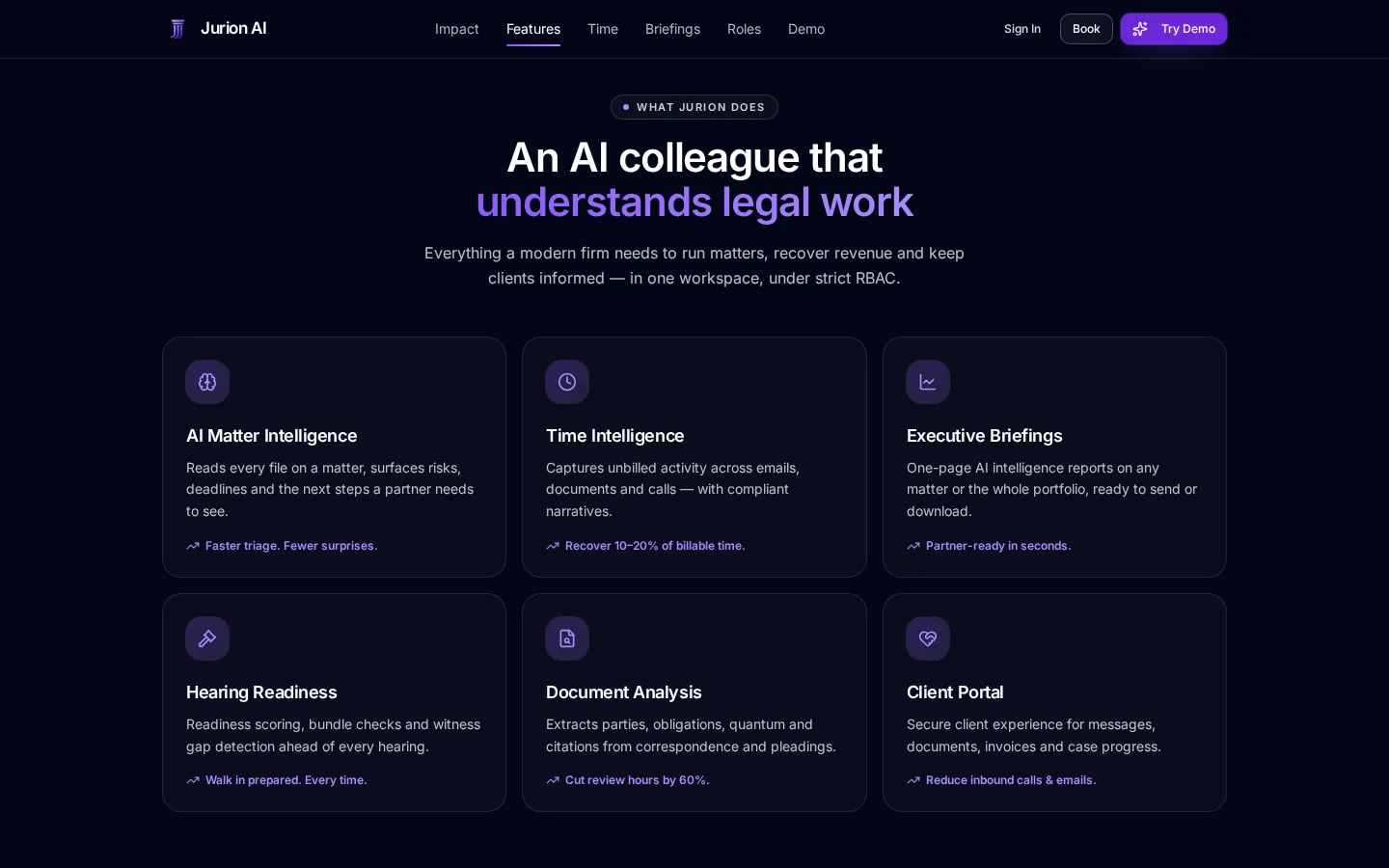
Matter intelligence
Reads every file, email and note on a matter, then flags the risks, deadlines and next steps a partner needs to see.
Document analysis
Pulls parties, obligations, quantum and citations out of pleadings and correspondence automatically.
Instant summaries
Plain-English summaries of any matter, bundle or briefing pack, on demand.
Next-action recommendations
Ranked by urgency, revenue impact and compliance risk, so triage stops being a guess.
Time recovery
Captures unbilled activity from Microsoft 365, calls and documents, and drafts narratives that hold up on a bill.
Time tracking
Live timers, a matter-scoped activity picker and retrospective reconstruction for the timer nobody remembered to start.
Matter management
Deadlines, tasks, documents and correspondence in one place per matter, with a health score to catch drift early.
Client portal
Secure messaging, key dates, documents, invoices and progress updates, all in one branded workspace.
Appointment booking
Clients can book straight into fee-earner calendars, with pre-instruction intake built in.
Proposal builder
Reusable templates, dynamic scope and fee blocks, and one-click quotes for repeat work.
Knowledge base
Firm-wide precedent, templates and playbooks that both people and the AI can search.
Reporting
WIP aging, revenue leakage, capacity by fee-earner and matter health across the portfolio.
Calendar sync
Two-way sync with Google Workspace and Microsoft 365 calendars.
Email capture
Correspondence linked to the right matter automatically, with activity logged as it happens.
Role permissions
Fine-grained access controls across every matter, document, client and invoice.
Hardened authentication
Session hardening, a full audit trail, and forced re-auth on anything sensitive.
Notifications
Prioritised, deadline-aware alerts with digest options for people who don't want another ping.
Automation rules
Routing, escalations, follow-ups and reminders, scoped to each role.
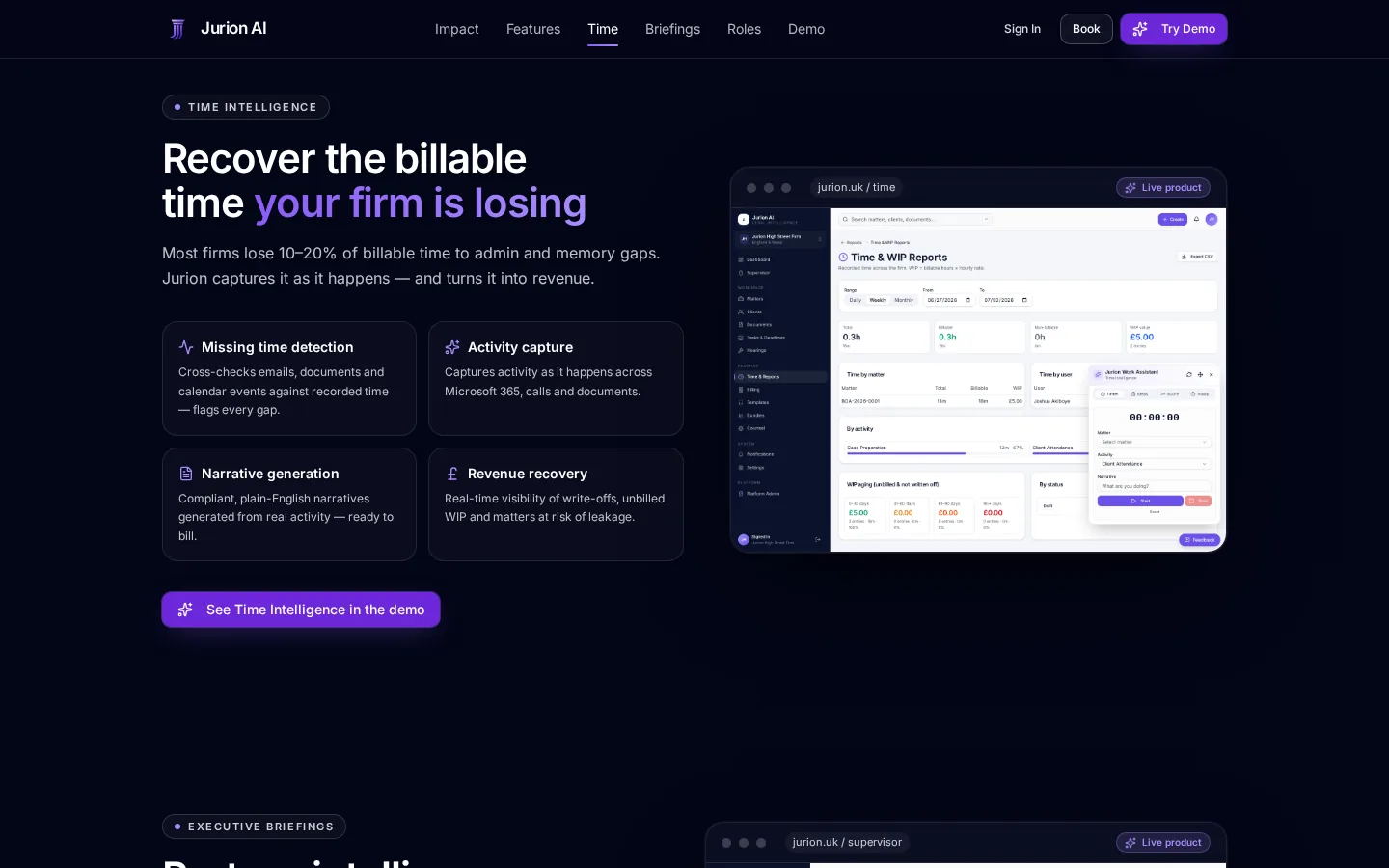
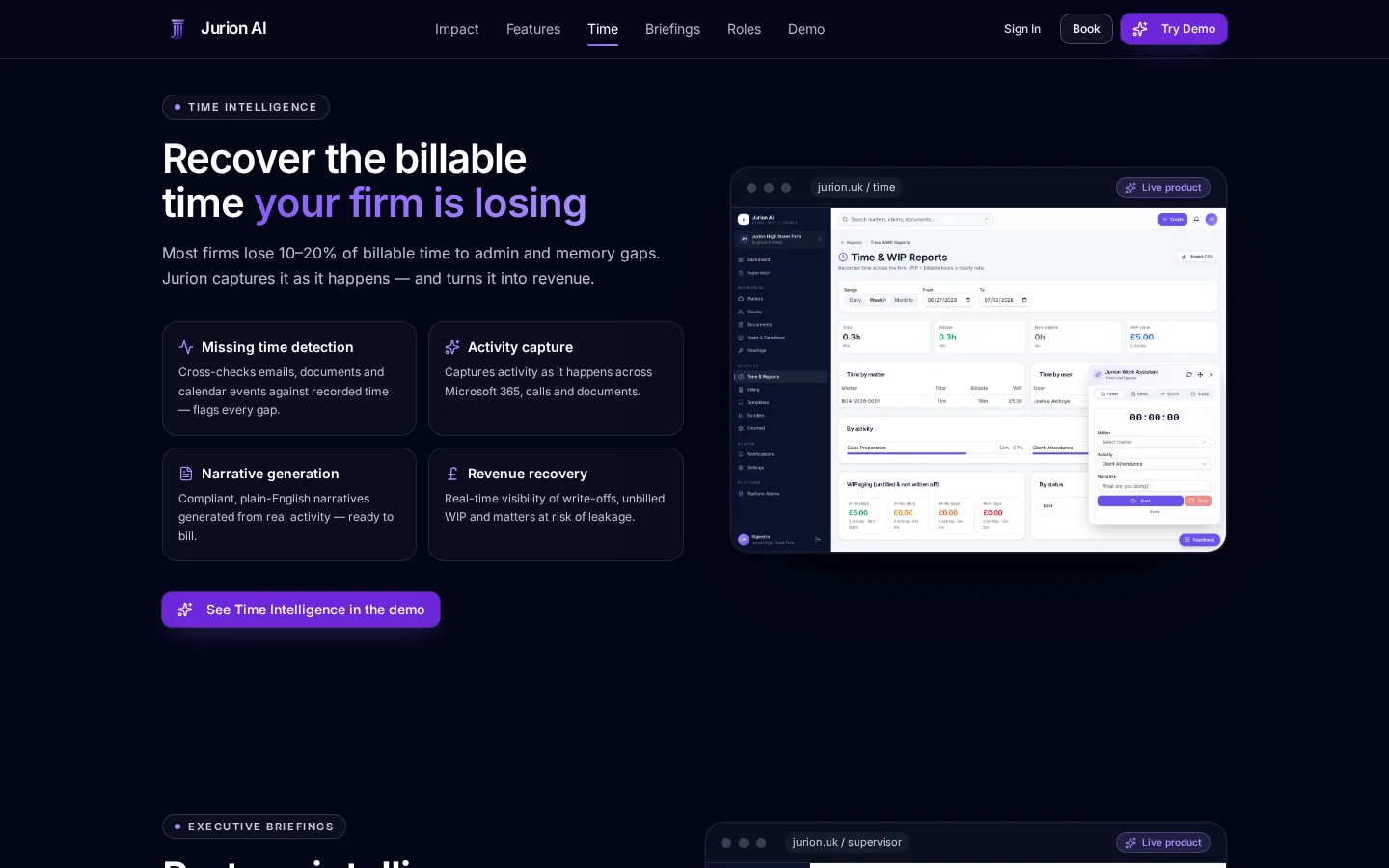
Reclaiming the billable time your firm is losing
Most firms lose ten to twenty percent of their billable hours to admin gaps and human memory. Jurion catches that work as it happens, rather than asking anyone to reconstruct it a fortnight later.
- Missing-time detection compares emails, documents and calendar activity against what's actually been recorded
- Activity capture across Microsoft 365, calls and documents, always scoped to the right matter
- Compliant plain-English narratives drafted from what actually happened, not guessed after the fact
- Live visibility of write-offs, WIP and matters where revenue is quietly leaking
Partner-ready intelligence in seconds
Partners don't want dashboards. They want a briefing. Jurion generates a one-page intelligence report on any matter, or the whole portfolio, ready to send, download or run through in a Monday morning stand-up.
Every briefing sits on top of the firm's own data and cites its sources. Nothing is fabricated, and nothing leaves the tenant.
Live intelligence, not lagging reports
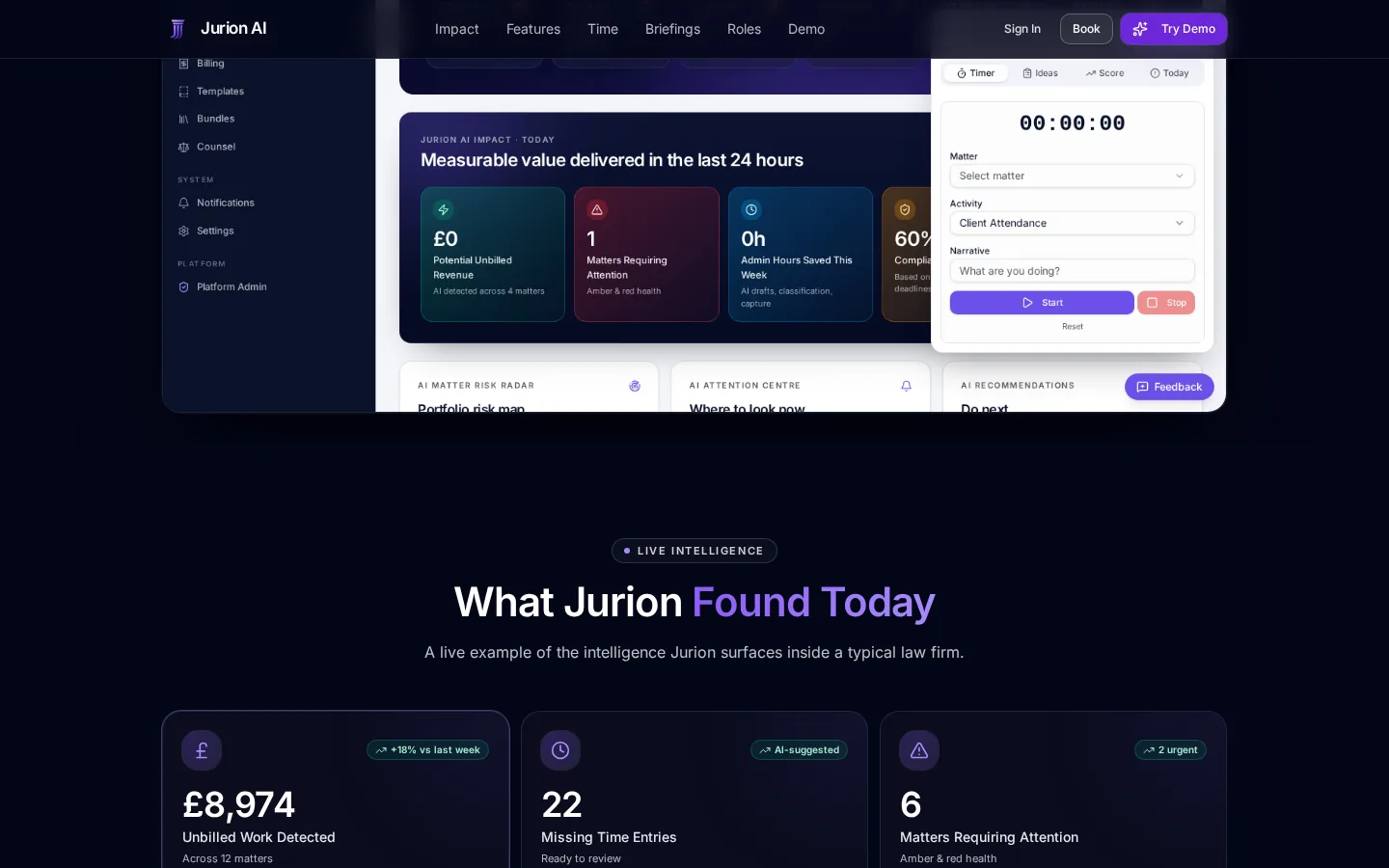
The Impact tile is the first thing a partner sees at login. Potential unbilled revenue, matters that need attention, admin hours saved this week and a compliance score against the deadlines ahead.
It exists to answer one question, in about three seconds, before anyone has had their first coffee. Does the firm need me to do something today?
Built to grow from one firm to a hundred
Frontend
React and TypeScript, route-level code splitting and server-driven data with optimistic UI. Every screen holds up from 320 pixels wide.
Backend and data
Postgres and Supabase for auth, storage and edge functions. Row-level security enforces access at the database, not just the interface.
AI layer
Structured prompt orchestration over the firm's own data. Every action goes through deterministic tool calls, and every AI response is logged so it can be explained after the fact.
Integrations
Native calendar sync for Google Workspace and Microsoft 365, secure OAuth for both, and matter-linked correspondence capture from either mailbox.
Security
Session hardening, forced re-auth on sensitive operations, encryption at rest and service accounts held to least privilege.
Observability
Full request tracing, a per-tenant activity audit trail and AI usage metering, so you can follow the story from a partner's login down to the tokens spent on a prompt.
Selected technology
- React
- TypeScript
- Supabase
- PostgreSQL
- Row-level security
- AI orchestration
- OpenAI-compatible models
- Google APIs
- Microsoft 365
- OAuth 2.0
- Role-based access control
- Server-driven UI
- Edge functions
- Structured logging and audit
Non-negotiable by default
Built for SRA, GDPR and AML
Data residency, audit trails and permission scoping shaped against the SRA Standards, UK GDPR and AML record-keeping requirements from day one.
Permissions enforced at the database
Row-level security policies sit on every tenant-scoped table. Access is checked server-side, not just hidden in the interface.
WCAG 2.2 AA
Every component built and tested against AA contrast, keyboard operability, focus management and screen-reader semantics.
From discovery to continuous improvement
Discovery
Fieldwork with partners, solicitors, paralegals and clients at UK firms. Jobs to be done, an audit of the tools already in use and a diagnostic for where revenue was leaking.Research
A compliance surface analysis against SRA, GDPR and AML rules, a competitive teardown of the practice management incumbents, and a hard look at what AI could and couldn't be trusted to do.UX strategy
A role-based product map covering partner, solicitor, paralegal, assistant and client. Each role got its own MVP scope and its own success metrics.Wireframes
Mid-fidelity flows for the main journeys in each role workspace, validated with our design-partner firms before anyone opened Figma.Visual design
A dark, high-contrast product language with tokens, components, motion primitives and a documented accessibility baseline.Development
We shipped auth, permissions, tenant isolation, the audit trail and observability before writing a single feature. Everything after that went out in vertical slices.Testing
An AI evaluation harness, permission-scoped regression tests and accessibility checks running alongside every release.Launch
An iterative beta with our design-partner firms, weekly feedback cycles, and prioritisation driven by real usage on the way to general availability.Continuous improvement
A public marketing surface, an interactive demo, and a roadmap that keeps being redrawn by how the platform is actually used.
Every stage carried the same discipline the platform expects of its users. Compliance came first, roles shaped scope, and every decision left an evidence trail. Tap any step to see how it played out on this project.
Engineering standards baked into every module
Mobile-first design
Role-specific mobile flows for triage, time capture and client messaging. Not a shrunken desktop.
Responsive layouts
Every module holds up from 320 pixels wide, tested against the real breakpoints partners work in.
WCAG 2.2 AA baseline
AA contrast, keyboard operability, focus management and screen-reader semantics, enforced across every module.
Semantic HTML
Proper headings, landmarks and ARIA, used only where the DOM can't already say what it needs to.
SEO foundations
A marketing surface built for discovery. Unique titles, descriptions, canonicals and product schema.
Performance
Route-level code splitting, image-format negotiation and server-driven data with optimistic UI.
Security
Row-level security on every tenant table, forced re-auth on sensitive operations and encryption at rest.
Frontend architecture
React and TypeScript, structured data flows and deterministic AI tool calls with a full audit trail.
Conversion-focused UX
Every role screen surfaces a single next action, ranked by urgency, revenue impact and compliance risk.
What the platform changes for a firm
- Billable time recovered
- 10 to 20%
- Review hours cut
- 60%
- Role workspaces
- 5
- Accessibility baseline
- AA
The time most firms quietly lose to admin, now captured as it happens.
Document extraction takes the first pass on pleadings and correspondence.
Partner, solicitor, paralegal, assistant and client, all drawing on one data model.
WCAG 2.2 AA across every module.
These figures are the platform's design targets, drawn from Jurion's own marketing surface at jurion.uk, and the industry-typical improvements the AI layer is built to deliver. Real results will vary with matter mix, data hygiene and how deeply the platform gets adopted.
Where the platform goes next
Deeper integrations
Native connectors for Actionstep, Clio and Leap, so firms can adopt Jurion without tearing out the practice management system they already own.
Advanced hearing readiness
Bundle checks, witness gap detection, court form drafting and pre-hearing intelligence packs.
Multi-office and multi-brand
Group-level dashboards, cross-office capacity balancing and brand-scoped client portals.
A workspace that follows the fee-earner
Legal work happens between courtrooms, taxis and client offices, rarely at a desk. The mobile experience isn't a shrunken version of the browser view. It's a focused, action-first look at the parts of the platform that can't wait. Notifications, deadlines, time capture and matter status.
- A prioritised notification digest tuned to each role
- One-tap time capture, always linked to the right matter
- A deadline-first matter view for triage on the go
- Secure client messaging with document previews

Three lessons from building the platform
Build the audit trail first
In a regulated sector, an AI action that isn't auditable may as well not have happened. Audit logging went live before the first AI feature did, and we'd do the same again on any comparable project.
Role-scoped defaults beat feature toggles
Five roles with sensible defaults are easier to adopt than one product covered in settings. Product simplicity is a compliance strategy in its own right.
Ground the AI in the firm's own data
No partner will trust a model that invents cases. Every AI output in Jurion cites its source inside the firm, and there's no external retrieval unless someone explicitly turns it on.
Content hub — Jurion AI
Client: Jurion AI Ltd
Industry: Legal Technology
Project type: Enterprise AI Platform
Services delivered: Product strategy, Research and UX, Brand and interface design, Full-stack engineering, AI layer
Problem
UK law firms sit on more data than most enterprises but lose an estimated ten to twenty percent of billable hours to admin gaps and human memory. The practice management systems they already own store information without ever interpreting it or suggesting a next move.
Approach
Discovery across five roles from managing partner to client, a compliance surface analysis against SRA, GDPR and AML rules, structured AI orchestration on the firm's own data, and an audit trail shipped before the first AI feature.
Solution
A legal intelligence platform built for SRA, GDPR and AML scrutiny. Five role workspaces, matter intelligence, time recovery, executive briefings, a client portal, and permissions enforced at the database with row-level security.
Outcome
A product that behaves like a senior colleague. It reads matters, recovers billable time, drafts narratives that would pass an audit, briefs partners in a single page and gives clients somewhere sensible to log in. Design targets: ten to twenty percent of billable time recovered, sixty percent of document review hours cut.
Key takeaway
In a regulated sector, an AI product is only trustworthy when every output is grounded in the firm's own data, scoped to the reader's permissions and auditable. Role-scoped defaults beat feature toggles, and the audit trail ships before the first AI feature.
Lessons
- Build the audit trail first. In a regulated sector, an AI action that isn't auditable may as well not have happened.
- Role-scoped defaults beat feature toggles. Five roles with sensible defaults are easier to adopt than one product covered in settings.
- Ground the AI in the firm's own data. Every Jurion output cites its source inside the firm.
Continue exploring
Related work, thinking and services
Related services
Related insights
Related projects
Case study
Boadu Legal Services
A brand-led legal consultancy website built around trust and qualified enquiries.
Read moreCase study
Co-Lab Creative Space
A brand refresh and website rebuild around the booking journey.
Read moreCase study
Focus & Flow CIC
A first digital home for a wellbeing community, built for a two-person team.
Read more
What's next
The roadmap beyond launch
Deeper integrations
Native connectors to Actionstep, Clio and Leap, so firms can adopt Jurion without replacing what they already own.
Advanced hearing readiness
Bundle checks, witness gap detection and pre-hearing intelligence packs.
Multi-office and multi-brand
Group-level dashboards, cross-office capacity balancing and brand-scoped client portals.
Continuous AI evaluation
An expanded, model-agnostic evaluation harness with per-firm precision, recall and hallucination scoring.
Planning an AI platform, internal software or a broader digital shift?
If you're an operator who knows a domain inside out, a partner with a real thesis, or a firm sitting on an unfair data advantage, this is exactly the work we take on.
Enjoyed this case study?
Share it with your team or save it for later.
Published Last updated